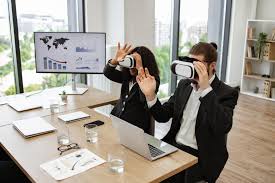
Remember when virtual reality was a futuristic fantasy reserved for sci-fi novels and arcade novelties? Fast forward to 2026, and VR has shed its “experimental” label to become one of the most transformative forces across entertainment and education . From hyper-immersive gaming experiences that blur the line between physical and digital to educational simulations that turn abstract theories into hands-on adventures, VR is fundamentally changing how we play and learn.
We are no longer asking if VR works, but rather how we can harness its full potential . In 2026, the technology is maturing rapidly, driven by advances in artificial intelligence, more accessible hardware, and a growing appetite for experiences that are not just passive, but deeply participatory. This article explores the cutting-edge trends reshaping both industries and offers a glimpse into a future where the digital world is not just viewed but truly inhabited.
I. The State of Virtual Reality in 2026: A Market on the Rise
Before diving into applications, it is essential to understand the landscape. The numbers paint a clear picture: VR is no longer a niche interest.
The global VR gaming market, valued at approximately $19.08 billion in 2025, is projected to surge to $22.27 billion in 2026, continuing its climb toward an estimated $57.43 billion by 2032 at a compound annual growth rate (CAGR) of over 17% . This growth is fueled by more than just enthusiastic gamers. The immersive technology sector in gaming alone is expected to grow at an even more staggering CAGR of 29.6% through 2030 .
What is driving this explosion? Key factors include:
- Hardware Maturation: Standalone headsets like the Quest and PICO series have lowered the barrier to entry, offering high-quality experiences without the need for expensive, tethered PCs .
- 5G Expansion: The rollout of 5G networks is enabling low-latency, cloud-streamed VR experiences, allowing for more complex and multiplayer environments on mobile devices .
- AI Integration: AI is becoming the engine of immersion, powering realistic non-player characters (NPCs) and dynamically generating interactive content .
II. Gaming: The Vanguard of Immersion
Gaming has always been the proving ground for VR technology, and in 2026, it is delivering on its long-standing promise of total immersion.
A. From Spectator to Participant: The Evolution of Gameplay
The core appeal of VR gaming lies in its ability to transform the player from a passive observer behind a screen to an active participant within the game world. This shift is being amplified by new technologies that engage more senses than just sight and sound.
- Haptic Feedback and Motion Tracking: In 2026, gaming is a full-body experience. Haptic suits and advanced controllers allow players to feel the impact of a punch, the recoil of a weapon, or the texture of a virtual object . Motion tracking translates real-world movements into the game with unprecedented precision, making a sword fight or a tennis match feel genuinely physical.
- Genre Diversification: While action and shooter games remain popular, the market is seeing significant growth in simulation, adventure, and even social experiences . From racing simulations with realistic steering wheel feedback to sprawling RPGs where players physically interact with the environment, the variety of experiences is expanding rapidly.
B. The Rise of Social and Location-Based VR
Gaming is becoming increasingly social. The days of the isolated VR player are fading as developers focus on shared, persistent worlds.
- Multiplayer and Social Platforms: While early visions of a unified “metaverse” have evolved, the core concept of social VR is thriving. Platforms are focusing on creating persistent spaces where friends can gather, play, and create together, moving beyond simple chat rooms to complex, game-driven social hubs .
- Location-Based Entertainment (LBE): For those seeking the ultimate immersive experience, location-based VR venues are booming. These arcades and arenas offer high-end, free-roaming VR experiences that are often unattainable in the home. Companies like Immersive Gamebox are being acquired and expanded, signaling strong investor confidence in out-of-home VR entertainment . These venues leverage the best hardware and social dynamics to create memorable group experiences.
III. Education: A New Reality for Learning
While gaming captures the imagination, VR’s potential to revolutionize education is perhaps its most significant contribution. In 2026, the focus has shifted from the “wow” factor to measurable outcomes. The game-based learning market, a close cousin to VR education, is projected to grow from $26.28 billion in 2026 to $68.16 billion by 2030 . This growth is driven by VR’s unique ability to make the abstract tangible and the dangerous safe .
A. Experiential Learning: Moving Beyond the Textbook
The pedagogical power of VR lies in “experiential learning”—the idea that we learn best by doing. VR creates a safe, controlled, and repeatable environment for this kind of active learning.
- Abstract Concepts Made Concrete: Subjects like quantum mechanics or molecular biology, which are notoriously difficult to grasp from a textbook, are being transformed. For example, a VR module on quantum mechanics has been shown to increase high school students’ learning effectiveness and motivation by allowing them to interact with wave-particle duality in a virtual lab .
- Impossible and Dangerous Simulations: VR allows students to practice high-stakes skills without real-world risk. From dental students practicing complex surgical procedures on virtual patients to chemical engineering students coordinating a response to a simulated plant accident, VR provides invaluable “muscle memory” and decision-making practice .
B. Proven Impact: The Research is In
In 2026, we are moving past the hype and into a phase of rigorous study. Research confirms that well-designed VR learning environments yield tangible results.
A recent pilot study of TUMSphere, a VR application that transforms a university’s STEM curriculum into a series of interactive mini-games, showed statistically significant knowledge gains (p < 0.001) with a large effect size (r = 0.86) . Students didn’t just think they learned more—they demonstrably did. The study also reported high usability and engagement scores, with negligible simulator sickness, addressing two of the most common historical barriers to VR adoption .
Georgia Tech is another institution at the forefront, piloting VR modules that allow students in its Online Master of Science in Analytics program to practice leadership and communication skills through branching 360° scenarios with virtual agents . As one researcher noted, “Virtual reality allows us to create emotionally resonant, high-stakes scenarios in a safe environment where students can experiment, reflect, and grow” .
IV. The Convergence of AI and VR: The “Sentient” Experience
The most significant trend of 2026 is the deep integration of Artificial Intelligence with VR. This convergence is giving rise to what some are calling “sentient worlds”—dynamic, responsive environments that adapt to the user .
AI is no longer just a back-end tool; it is becoming the interface for learning and exploration.
- AI Mentors: Imagine watching a VR simulation of a historical event and then being able to have a real-time conversation with an AI-powered avatar about the complex geopolitical factors that led to it. Platforms like EON Reality’s “EON Sentient Worlds” are doing exactly that with “Brainy,” an AI mentor that engages in context-aware dialogue to deepen understanding .
- The Progressive Immersion Ladder: To ease users into these experiences, designers are using a progressive approach. A user might start with a short cinematic video, then move to a conversation with an AI, then explore a 3D environment, and finally bring that model into their own living room via AR. This ladder balances engagement with accessibility, ensuring that users are not overwhelmed .
V. Overcoming Challenges and Looking Ahead
Despite the incredible progress, the path forward is not without its hurdles. Understanding these challenges is crucial for anyone looking to invest in or adopt VR technology.
A. Hardware and Economic Barriers
While standalone headsets are more affordable than ever, the cost of high-end VR equipment, including haptic suits and powerful computing rigs, remains a barrier for many individuals and institutions. Furthermore, global tariffs implemented in 2025 have increased costs for imported electronics, including VR headsets and components, impacting supply chains and pricing strategies for manufacturers .
B. The “Novelty Effect” and Design Quality
Researchers caution against the “novelty effect,” where initial engagement with VR is high simply because it is new, not because it is effective. To counter this, studies emphasize the importance of structured onboarding and thoughtful instructional design. If a student spends all their cognitive energy figuring out how to use the controllers, they aren’t learning the subject matter . The quality of the design matters as much as the technology itself.
C. The Future: From Hype to Mainstream
Looking ahead to 2035, experts predict that VR and AR will evolve into “seamless reality layering,” where digital and physical worlds coexist and interact in real-time . For education, this means a future where immersive learning is a standard part of the curriculum, not a special event. For gaming, it means richer, more persistent worlds where the line between online and offline social interaction continues to blur .
Conclusion: A World Without Limits
Virtual reality in 2026 is a story of maturation. It has moved beyond the hype cycle to become a tool of genuine utility and wonder. For gamers, it offers an unparalleled level of immersion and a new frontier for social interaction and creativity. For educators and students, it provides a key to unlock complex subjects, a safe space for practice, and a powerful engine for curiosity.
As the technology becomes more accessible, the hardware more powerful, and the software more intelligent, the question is no longer if VR will transform how we play and learn, but how quickly we will embrace its full potential. Whether you are a developer, an educator, or simply a curious enthusiast, now is the time to step into the new reality.